As the first trimester comes to an end, our Songwriting Skills portfolios are due along with our History of Song research papers. Below you will find and the research paper that landed me an A in my first course of my Masters degree and it the first third of my Master's thesis due in a few months!
Wear Your Heart on Your Songs
Analysis of the Themes, Characteristics,
and Influences of My Songwriting
Introduction
Donald Brackett suggests, “the talents and pathologies of singer-songwriters are manifested in the songs they write…and through their roles in the larger theater of our popular culture. They somehow serve as our dark mirror” (Brackett, 2008: x)
Throughout history, music has played an invaluable role in communicating emotions, traditions, and ideas. Rightfully called the universal language, music serves as an outlet for creative communication from musician to listener. While focusing on the genres of singer-songwriters, I will deconstruct and examine my own songwriting tendencies and characteristics relative to my influences. Using three of my original songs, Let Me Go, One Step Closer, and So Lost, I will touch upon song form, metaphorical language, and production value and how they relate to my influences. I wear my heart on my songs and aim to use my talents to reach others through them. Through form, content, and recording, I strive to convey my ideologies and messages to my listeners through my own mirror.
My Songwriting
You can tell a lot about a songwriter by their influences. However, my influences are not strictly other songwriters, but other singers. My past is enriched with music. I have been professionally studying voice for ten years. Until I realized the power of the songwriter, I was infatuated with the idea of the singer. This built the foundations of my musical self and eventually the songwriter in me. Early on, I found contentment through singing powerful lyrics of other artists. I Hope You Dance, by Leanne Womack, Via Dolorosa, by Sandi Patti, Seasons of Love, from RENT, and Breathe 2am, by Anna Nalick are examples. Tedder states, “I discovered that…a lot of artists didn’t write their own music [it was] like telling you that Santa Claus isn’t real. And I couldn’t believe it” (ASCAP, 2012). This realization happened for me too, and my life in music changed. I was a singer who became a musician.
Zollo writes “There’s an unmistakable elegance in Dylan’s words…[Dylan] refers to it as ‘gallantry’… and pointed to it as the single thing that sets his song apart…all of his songs possess this exquisite care and love for the language” (2003: 70). As Dylan’s music is to poetry, mine is to vocals. As Dylan’s songs are not just poetic lyrics, mine are not simply vocal-centric. I strive to have as much meaning in the tone of my voice as the words I sing. My songwriting influences consist of current artists including Sara Bareilles, OneRepublic, and Barcelona—all featuring strong vocals and a piano core.
My Influences
Sara Bareilles is a California native, singer-songwriter who has significantly influenced my music. I may not emulate her jazzy, soul-rock, pop sound, but her lyrics and song form are at the top of my inspiration list. She has a strong, beautiful voice that pairs perfectly with her incredible talents as a pianist. She defies the rules of pop mainstream music, while eloquently sitting inside the framework. She caters to the vulnerable, tortured singer-songwriter and can bring a country to her feet with uplifting lyrics of empowerment, self-worth, and strength.
My taste in music has changed seasonally throughout my life. There are artists that will always have a place in my heart, but some continue to stay relevant, following me throughout my changing seasons. OneRepublic has proven to be one of those bands, specifically lead singer, Ryan Tedder. I started listening to OneRepublic the same time as I started writing and Tedder has consistently been a role model, inspiration, and influence in my writing, musicianship, and understanding of song form, lyrical use of language, and instrumentation.
From Seattle, Washington, three-member indie piano rock band, Barcelona, has yet to hit mainstream spotlight. This emerging American band holds their own next to Grammy award winning Bareilles and singer-songwriter/producer/musician, Ryan Tedder, with their incredible sense of arrangement, harmony, and lyricism. There is something so astounding about this band and their influence resonates throughout my music and aspirations. They were the leading melodic and instrumental influence for my first album, Let Me Go, and my designated listening for any inspiration.
Song Form
I want to hear music that has a message, and I want to hear messages that have an impact. A song loses power when lacking (prose), or unity, a fitting performance, and/or lack of structure. “Song form should be your friend, helping you deliver your message with power” (Pattison, 2009: 250). My songwriting technique in a word is form. Without fail, most of my songs follow the verse/chorus/verse/chorus/bridge/chorus structure. I write my songs like essays—developing the themes, ideas, plots, etc. using dynamics, chord changes, instrumentation, and especially placement of content.
Verse
- Let Me Go – Every night I’m sleeping next to the chains I adore/And every time I’m thinking about how I want so much more (Stephens: 2013)
- Machine Gun – Tell me off in a letter completely ignore me/Getting high off of saying why you don’t adore me (Bareilles: 2010)
- Come Back When You Can – I’ve been led on/To think that we’ve been trying for too long (Barcelona: 2009)
- Come Home – Hello World, I hope you’re listening/Forgive me if I’m young, for speaking out of turn/But there’s someone I’ve been missing/And I think that they could be the better half of me (OneRepublic: 2007)
I start off with imagery of two people in bed and one is realizing they want more than this. It’s relatable, giving the listener an idea of the general context, and reveals enough to be interesting without impeding on the other sections’ purposes.
Sara uses imagery and specific details start strong and hit the listener with curiosity. She doesn’t reveal the ultimate meaning, but implies through shared human experiences that relationships with bitter, spiteful partners is unpleasant. The last two songs are similar.
Pre-chorus
- Let Me Go – I’m tired of pretending that I’m happy when I’m not/I'm tired of convincing myself it will get better when it wont/I don’t want to be in between my life, my dreams, and you/I don’t want to be in between living and loving you (Stephens: 2013)
- Machine Gun – And drag me down, sight set proudly/Bring me to the ground see/You love to be somebody’s enemy (Bareilles: 2010)
- Come Back When You Can—Oh you look good with your patient face and wandering eyes/Don’t hold this war inside (Barcelona: 2009)
- Come Home – In the wrong place trying to make it right/And I'm tired of justifying/So I’ll say to you (OneRepublic: 2007)
My pre-chorus gives the song more weight and clarity while building to the chorus. The last line is the end of a completed idea functioning as a conjunction (thus, so, but, and).
Each of the above pre-choruses could have any of the conjunctions after them and, in the context of the choruses to follow, would make sense. Machine Gun and Come Back When You Can are the odd balls in this grouping with verse/pre-chorus/verse/pre-chorus structure before actually hitting the chorus. Come Home literally states the conjunction.
Chorus
A chorus, by definition, are works sung in unison (Collins English Dictionary: 2009). Choruses are meant to be memorable, catchy, and simple. The chorus summarizes the song and since it repeats, needs stay relevant throughout the song while continuing to be memorable rather than a boring repetition. Pattison illustrates this concept stating “Your job as a songwriter is make your repetition interesting and productive so that the same words deliver more each time” (2009: 55). The chorus is the resolution to the first half of the conjunction.
- Let Me Go – Let me go, turn over forget where I lay/Let me go, I promise it wont hurt one day/Let me go, close your eyes and I’ll slip away (Stephens: 2013)
- Machine Gun – Maybe nobody loved you when you were young/Maybe boy when you cried nobody ever come/Will you try it once, give up the machine gun, machine gun (Bareilles: 2010)
- Come Back When You Can—Oh, come back when you can/Oh, Let go you’ll understand/You’ve done nothing at all to make me love you less/Oh, come back when you can (Barcelona: 2009)
- Come Home – Come home, come home, I’ve been waiting for you for so long, so long/Right now there’s a war between the vanities all I see is you and me/The fight for you is all I’ve ever known/So come home (OneRepublic: 2007)
"[It is] the high point of a lyric’s energy…in the chorus you declare what the song is really about. Put your most focused, most memorable phrases into the chorus. Chorus lyrics tend to be simpler in meaning…in many songs verses are about talking and choruses are about shouting" (2006: 51).
Since chorus form trumps most other forms in current popular music, choruses have the most impact in the song. However, the chorus can’t stand-alone otherwise it would be chorus/chorus/chorus form. Even though the song now folds in half, something must change in the second half to keep the listener interested until the next chorus.
Second Verse and Pre-chorus
- Let Me Go—What we had was great but it isn’t enough, its not enough/And I cant ask for changes when I know you give me all of your love/So how much time must pass by before I find the strength to say goodbye/I cant lie and I wont be blind to the emptiness I feel inside (Stephens: 2013)
- Machine Gun—Locked and loaded you practically floated away now/In your fortress you feel like your more or less safe now/But let me say I don’t mean harm/Oh but baby, you’d be charming if you’d come undone/Get back where you started from (Bareilles: 2010)
- Come Back When You Can— You left your home/You’re so far from everything you know/Your big dream is crashing down and out your door/Wake you and dream once more (Barcelona: 2009)
- Come Home—I get lost in the beauty of everything I see, the world ain’t half as bad as they paint it to be/If all the sons and all the daughters stop to take it in/Hopefully the hate subsides and the love can begin/It might start now/Maybe I’m just dreaming out loud (OneRepublic: 2007)
They extend the concept, giving the upcoming chorus a new, brighter (or darker) meaning. The lines that are sung differently are outlined in bold showing this microform is common across this genre. Let Me Go turns from being unhappy in the relationship to clarifying that the partner has done nothing wrong, laying out the predicament of the dilemma more vividly. Machine Gun goes from listing venomous actions to her telling him he could be charming (with the right therapy). Come Back When You Can illuminates that she has lost her dreams and/or ambitions in pursuit of making him happy, countering the idea that he is leaving her because they don’t fit. Come Home widens the perspective from their separation to the systemic reasons behind it (war).
Bridge
Bridges are sacred and sometimes I write them first, I like them so much. They’re the part of the song that can take liberties like key changes, tempo changes, and meter changes. Rooksby agrees saying “bridges usually contain some sort of contrast with what is going on in the verse and chorus. A bridge can be the section…where alternatives are explored” (2006: 52). I like to give my audience something to cry for or think about in the bridge. I use secondary dominants and chromatic mediants in my bridges and introduce chords I will use once. Bridges are unpredictable thus why these four songs with nearly identical structure possess completely different bridges.
Metaphor
It would be silly to say that my music is characterized and differentiated by the use of metaphor. Metaphor is not only present in most song lyrics, but is found in the roots of most languages. Geary says, “We utter about one metaphor for every ten to twenty-five words, or about six metaphors a minute” (2010: 5). The use of metaphorical language in my music is practically inevitable and completely essential. In Songwriting Without Boundaries, Pattison elaborates,
All those specifics [who, what, when, and where] you learned to wade into can be even more interesting if they’re not only what they are, but become more than they are—they can transform or be transformed if they are seen through the lens of another idea (2011: 49).
The greek root meta means over, across, or beyond and phor means to carry. So metaphor means to carry across. We assign meaning and metaphor by “…juxtapos[ing] two different things and then skew[ing] our point of view so unexpected similarities emerge” (Geary, 2010: 9).
Using my song One Step Closer, OneRebublic’s Mercy, and Bareilles Gravity, I will demonstrate how metaphor applies to and inspires my writing. I’ve been intrigued by metaphor from a young age and began drilling my parents about metaphors at seven. My mother would give me a new one each day to wrap my head around. It wasn’t long before the entirety of my conversational skills became rife with metaphorical language. Metaphor is about more than just words, “we think metaphorically. Metaphorical thinking is the way we make sense of the world, and every individual metaphor is a specific instance of this imaginative process at work” (Geary, 2011: 10-11).
Stevie Rae Stephens’ One Step Closer
The first is without rain, we’d never see the spring. This says if we never felt bad things, we can’t appreciate great things. I created a metaphor illustrating that ugly, rainy days in winter make spring beautiful with radiant plant life and brilliantly clear skies. A leap of faith is a common metaphor for taking chances. I’m using it to say that despite how scary leaving a relationship is, we should trust our instincts, risking the chance of falling for the possibility of landing on our feet. Next in the chorus is go ahead and have your heart back/’cause I’m not leaving without mine. The heart is a vital organ and muscle, pumping blood to every corner of the body through a network of approximately 100,000 miles of vessels. This beating organ represents love, an intangible feeling transformed into a physical gift exchanged between partners. Geary rationalizes this idea in writing quite incredibly.
Without conceptual metaphors…we would have no way of talking about—or even thinking about—abstractions like love, beauty, suffering, and joy…Metaphorical thinking creates a kind of conceptual synesthesia…The abstract is understood in the context of the concrete, the metaphysical in the context of the physical, the emotional in the context of the biological. Through metaphor, body and mind are inextricably intertwined (2011: 91-93).
Once they realize the partnership is no longer beneficial, they should divide their metaphysical assets and part ways without the unnecessary allowance of extreme emotional self-destruction. Instead, I say we don’t have to break to know it was real/we don’t have to make mountains from hills, which is a colloquialism for transposing smaller issues into bigger ones. One of my favorite techniques is turning to the ultimate book of proverbs and metaphors—the Bible. It’s common to say love is blind, which is a double metaphor because it personifies love while making it blind! It means we cannot predict or control who/what our affections will target. “Greater love has no one than this: to lay down one’s life for one’s friends” (The Bible, John. 15:13), is the verse behind greater love self denies, which personifies love and says the most powerful kind is selfless. Because its true, we let each other loose completes the idea by referencing the metaphor if you love someone, let them go. Concluding the verse, fire burns to pave the path for new alludes to controlled forest fires that promote growth of new forestry—life birthed from ashes. The bridge consists of metaphors including moving towards a better day, tryings turned to pain, and this masterpiece we’ve made. Time isn’t a destination, but a concept, yet we move toward better times. To try is an action, not a physical solid, yet it has turned into an insubstantial feeling—pain. A masterpiece is a work of art, but has evolved to denote any great creation including a relationship, and in this case, one that once was.
OneRepublic’s Mercy

The first verse of Mercy is an extended metaphor portraying good fortune as an Angel that read a newspaper about the singer. He describes his fragile, human anatomy and/or his mindset as hardened. Next, fall apart now, is an extreme metaphor for becoming mentally incapable and a minor metaphor for having a period of sadness, opposed to having limbs fall off his body. Falling apart is an overused expression for becoming very emotional; I’ve used it in my songwriting and everyday conversation. These metaphors begin inheriting their meanings as they are immersed into the language. Pattison writes, “a metaphor is a collision of ideas” (2011:49). When things fall apart, they tend to be broken. Saying someone is broken when they are not working in their usual manor is a fair comparison. The chorus contains two major metaphors, how did you pick me up again and why am I on my feet again. These are related to falling on the ground and being in an unfortunate situation in life. Tedder continues with fly me to nowhere/it’s better than somewhere. One cannot fly, but board the vessel that does. He uses these expressions to illustrate the mindset of giving up.
Lastly, Tedder refers to himself as so lost in the Angel of mercy—a metaphysical immersion inside the will of this metaphorical Angel, rather than a literal labyrinth inside of another being. Just as One Step Closer uses metaphor to paint the pictures of a healthy, parting relationship, Mercy sculpts the bewilderment and appreciation for fortunate occurrences through metaphorical language.
Sara Bareilles’ Gravity
You hold me without touch/you keep me without chains describes being held without restraints, meaning they are held against better judgment by their own will. She says I want to drown in your love and not feel your reign, or wanting to be consumed by love without the price of being owned physically or emotionally. To drown in love is an interesting use of metaphor since love is often thought of as a positive emotion, however; Bareilles uses juxtaposition to illustrate this particular love.
The paradox of metaphor is that it tells us so much about a person, place, or thing by telling us what that person, place, or thing is not…A metaphor is both detour and destination, a digression that gets to the point (Geary, 2011: 12-13).
Addicts “use” to experience the effects regardless of the repercussions—they want to drown in the high without the addiction. Though Einstein’s theory of relativity proves all things with mass warp spacetime (has a gravitational field), I doubt Sara is literal when she sings I don’t want to fall another moment into your gravity. It’s a metaphor for being mentally/emotionally drawn to something/someone. Again, falling appears and still translates into a negative gesture of failing, succumbing, or diminishing. She refers to herself as fragile, and though humans are, she means an emotional fragility without addressing her emotions. Her bridge continues along the gravitational trajectory with I live here on my knees. It would be painful to live on your knees, but it’s a mental picture of having permanently fallen. This submission is elaborated with here on the ground. You’re keeping me down is the final climactic summary of the song.
These metaphors are not uncommon or re-imagined; they’re living in our vocabulary, becoming solidified, and inheriting new definitions. These are a few songs that scratch the surface of metaphorical influence on my music. They all have similar figurative language pertaining to my genre of songwriting. Metaphor will always be in my writing, conversation, and music because I need its lens to understand the world and myself better.
Production Value
Having a BA in recording has expanded the horizons of my songwriting. I find that my writing has improved commercially, harmonically, and structurally since I dove into recording. I started experimenting with recording after I began songwriting, but I wasn’t fully capable of realizing my songs’ potential until becoming well versed in it. In Songwriters on Songwriting, Lindsay Buckingham says, “Because the writing is so tied into the process of recording, it all becomes like strokes on a canvas. The work isn’t really just sitting down at a piano…the work is going in and making a record” (2003: 469). Some of my songs came alive in the studio in ways I never imagined. In this day and age, recording and songwriting can go hand in hand.
Since recording my album, I listen to Barcelona for inspiration. Though I listen to Sara and OneRepublic as well, I draw the most inspiration from Barcelona. Two of the songs on my album are influenced by Barcelona’s production including So Lost. It’s definitely an emotional ballad, but I didn’t want that live, acoustic sound and knew I could have full production without compromising the emotional integrity of the lyrics. Like Barcelona’s First Floor People, So Lost features a slow kick-snare pattern with an “underwater” effect introduced after the first chorus. The effect is taken off once the second chorus hits and the drums are placed normally at the forefront of the song. This same technique is used in Bareilles’ song, Come Round Soon.
www.wearebarcelona.com
Many established artists talk about “marriage” between lyric and music being an important factor in commercial songwriting. I completely agree. My early recordings were vocals and piano because I was still learning and recording for the sake of documenting. People were unimpressed at times because I’m a big vocalist and my music was not married to my lyrical or vocal emotion. I knew my genre wasn’t acoustic singer-songwriter. When entering the studio to start recording my album, it felt like I rewrote my songs with instrumentation. Songs that originally never made the top twelve were re-envisioned finding themselves the strongest on the album. One of the saddest, slowest, longest, and oldest songs was my least favorite until a guitarist played over all five minutes of it with three tracks worth of electric guitar. I never thought an extended guitar solo was exactly what it needed to become a favorite again. When I couldn’t build the song vocally, I was able to build the song digitally. With the help of my studies, I’m able to hear the fine details of how the recording and songwriting process are one in the same. This skill translates to how I hear my influences music too. I consider myself a better songwriter with this training and understanding under my belt.
Conclusion
By deconstructing mine and my influences’ songs, I am able to analyze the tendencies and characteristics of our songwriting allowing me to elaborate on the similarities, origins, and tropes within them. The importance of song form/content is conveyed through a closer look at Let Me Go, Machine Gun, Come Back When You Can, and Come Home. The depth of metaphor is broken down in One Step Closer, Mercy, and Gravity. Lastly, the impact that production and the process of digital recording has on mine and others’ music is illustrated in So Lost, First Floor People, and Come Round Soon.
This universal language of music brings us together in ways we don’t see nor understand making the gift of songwriting invaluable. Through these topics, I aim to reach my audience just as my influences have reached me. It is absolutely remarkable that a literary, emotional, historical, and even psychological world can be found in the three-minute life of a song. Through songwriting, we can illuminate “…the dark corners where we thought we dwelt alone” (Brackett, 2008: 44).
Bibliography
Barcelona (2009) ‘Come Back When You Can’, Absolutes. [Mp3], Universal Motown.
Barcelona (2009) ‘First Floor People’, Absolutes. [Mp3], Universal Motown.
Bareilles, S. (2008) ‘Come Round Soon’, Little Voice. [Mp3], Epic.
Bareilles, S. (2008) ‘Gravity’, Little Voice. [Mp3], Epic.
Bareilles, S. (2010) ‘Machine Gun’, Kaleidoscope Heart. [Mp3], Epic.
Brackett, D. (2008) Dark Mirror: The Pathology of the Singer-Songwriter. Westport, CT: Praeger.
Collins English Dictionary – Complete and Unabridged. (2009) 10th Ed. HarperCollins.
Geary, J. (2011) I Is an Other: The Secret Life of Metaphor and How It Shapes the Way We See the World. New York, NY: HarperCollins.
Morrish, J. ed. (2006) Lyrics: Writing Better Words for your Songs. London: Outline Press.
OneRepublic (2007) ‘Come Home’, Dreaming Out Loud. [Mp3], Interscope.
OneRepublic (2007) ‘Mercy’, Dreaming Out Loud. [Mp3], Interscope.
Pattison, P. (2011) Songwriting Without Boundaries. Blue Ash, OH: Writer’s Digest.
Pattison, P. (2009) Writing Better Lyrics. 2nd Ed. Cincinnati, OH: Writer’s Digest.
Rooksby, R. (2006) Lyrics: Writing Better Words for your Songs. London: Outline Press.
Ryan Tedder on Songwriting at the 2012 ASCAP “I Create Music” EXPO (2012) [YouTube] ASCAP. Available from: http://www.youtube.com/watch?v=4BgXIopnSyo. [Accessed 7 November 2013].
Stephens, S R. (2013) ‘Let Me Go’, Let Me Go. [Mp3].
Stephens, S R. (2013) ‘One Step Closer’, Let Me Go. [Mp3].
Stephens, S R. (2013) ‘So Lost’, Let Me Go. [Mp3].
The Bible: New International Version. (2011) Biblica.
Zollo, P. (2003) Songwriters on Songwriting. 4th Ed. Cincinnati, OH: Da Capo Press.
Annotated Bibliography
Zollo, P. (2003) Songwriters on Songwriting. 4th Ed. Cincinnati, OH: Da Capo Press.
This compilation of interviews with songwriters from almost every genre of popular music provides an in-depth analysis of the songwriting techniques and history of songs and songwriters that shaped the face of American music today. Interviews with sixty-two songwriters uncover personal, historical, and technical aspects of their most famous and favorite songs. Getting this peak into the mind of the many songwriters that inspired, motivated, and changed the way music is written today gives clarity and even insight to budding songwriters looking to find their voice. Artists such as Alanis Morissette and Suzanne Vega, and Bob Dylan give eye-opening interviews regarding their best songwriting.
Geary, J. (2011) I Is an Other: The Secret Life of Metaphor and How It Shapes the Way We See the World. New York, NY: HarperCollins.
James Geary proves in this amazing and incredibly interesting book that every aspect of our human experience is molded and drenched in metaphor. Geary proves this point with the aid of literary, scientific, philosophical, medical, historical, psychological, and etymological research and references. From the beginning of human communication and present day communicatory means, this work leaves no stone unturned, touching upon metaphor and thought, money, advertising, politics, science, and proverbs. Focusing on individual chapters relating metaphors to the mind in literary and linguistic senses, I can better understand the use of metaphor in my musical influences as well as in myself.
Pattison, P. (2009) Writing Better Lyrics. 2nd Ed. Cincinnati, OH: Writer’s Digest.
Writing Better Lyrics has become a must-have staple for songwriters since 2007 with effective tools from song form and structure, to drawing inspiration and generating ideas. Pattison relays the concepts and techniques of songwriting through vivid and imaginative metaphors and stories, making the process of songwriting an explainable and attainable art form. Using specifically chapters 10, 18, 19, 20, 22, and 23 relating to perspectives, rhyme scheme, song form, structure, and prose in motion, I will be able to better understand the songs that have influenced me and my own songs.
Morrish, J. ed. (2006) Lyrics: Writing Better Words for your Songs. London: Outline Press.
From start to finish, this manual of songwriting techniques and processes offers advice and direction in creating the original idea, drawing inspirations, painting songs with imagery, and shaping the final work. The book travels through the numerous ways to write successful songs such as title techniques, the power of metaphors and similes, song forms, and point of view. In addition, interviews are conducted with successful songwriters and well-known examples of techniques and exercises in songwriting are provided with each new step. The text studies a collection of general songwriting practices and approaches and how they were used in writing some of the most successful commercial songs today.
Brackett, D. (2008) Dark Mirror: The Pathology of the Singer-Songwriter. Westport, CT: Praeger.
Dark Mirror revolves around the idea that singer-songwriters paint our world of music with the reflection of their soul. Brackett exposes the inverted pathology of the singer-songwriter through evaluation and analysis of individual artists’ works and techniques. The book expresses the idea that songs from within have the ability to touch audiences deeply even though some songs are distinctly direct reflections of the songwriter’s mentality and/or emotions. Each chapter uses different accomplished songwriters such as Amy Winehouse, Jack and Meg White, David Bowie, Tom Waits, and Bob Dylan to explain the many different mirrors that listeners so quickly consume as their own internal voices. Through these incredible songwriters, we are able to communicate for and to ourselves.

 It was nice being back in the classroom with Richard. It feels like ages since we all last saw each other. This course will prove to be a challenging and intriguing exercise in the world of music and, in my case, publishing and the music business. We convene every Wednesday from noon to whenever and will be composing a beefy 10,000 word research paper on a topic and thesis of our choice. This first class meeting was half spent going over our ideas for the papers and half spent in a master class with BASCA Business Development Officer, Rowena Morgan.
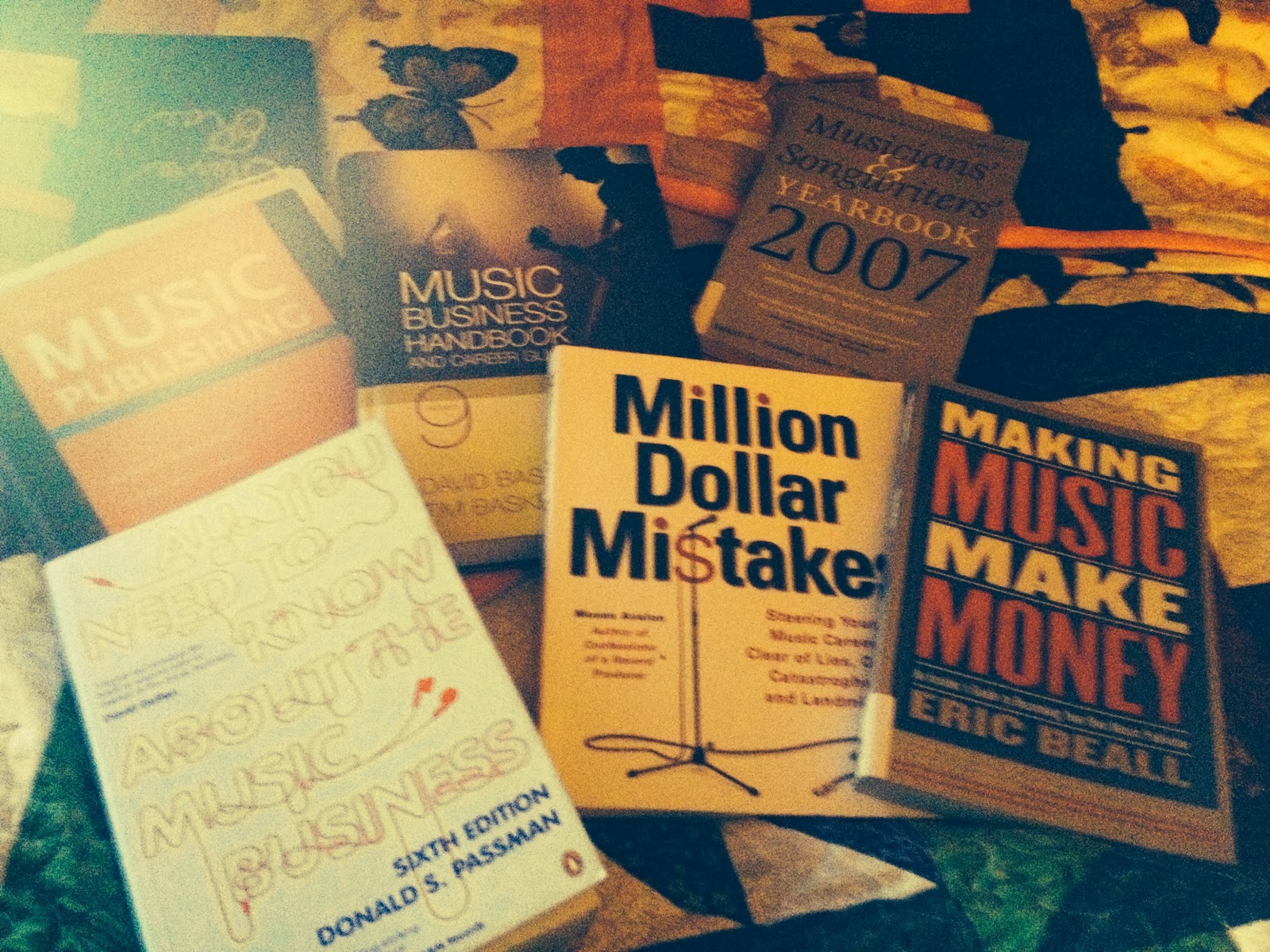 If I were to sell myself right now, I would say that I am a vocalist, songwriter, and recording engineer with demos to back it up. SO... how do I find a way to incorporate that particular skill set, a strategy for getting published, and academic, scholarly research to back it up into a narrow topic? I guess I will find out once I start quote searching through the handful of books I rented from the library today.
 You Oughta Be In Pictures by Mare Wakefield and Performing Songwriter, May 2009

 Before this event I'm going to, I should create a shopping list of all the people I need/want to meet. The person you need the most may not be the person you think you need the most so you basically need to know them all.... Rowena says the first 50 friends you make will be the hardest ones. After 100, it gets easier. Knowing one person is like having a gold membership on a credit card.